
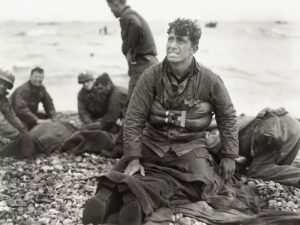
Second Lieutenant Walter Sidlowski of 348th Engineer C Battalion, 5th Engineer Special Brigade, on Omaha Beach, Normandy. Sidlowski was helping rescue a group of drowning soldiers after their landing craft sank on the morning of June 7, 1944. Walter Rosenblum/U.S. Army Signal Corps/Galerie Bilderwelt/Getty Images
Eighty years ago, the world suffered because one man in Europe had seized control of his country’s military, industry and the press. He did away with checks and balances by appointing sycophants to run the government and using the courts as instruments of control. He quashed all dissent at home and demonized groups of his own country’s citizens. Once this authoritarian had complete control of the levers of power, he unleashed his country’s might on its neighbors. Europe and the world watched while the countries he invaded crumbled. Some tried to appease and accommodate him but failed. He soon occupied virtually all of Western Europe, including France.
Britain stood firm. He unleashed waves of bombers and U-boats against Britain.
The United States stood firm. He unleashed more U-boats against the United States, beginning with American ships on the Atlantic coast and then across the North Atlantic.
Thus, 80 years ago, we defended ourselves and our allies by launching a naval armada of some 7,000 ships and almost 160,000 American, British, Canadian and French troops. They crossed the English Channel to land under fire on the occupied beaches in Normandy. Another 13,000 American soldiers came by parachute and 4,000 by glider, all to engage in ferocious fighting on enemy-held shores and in Normandy’s towns, farms, hedgerows and roads. We and our allies had one goal: to take back what autocracy had stolen.
The price was high. More American soldiers and sailors died on June 6 than were killed in the Japanese attack on Pearl Harbor. By day’s end, 2,501 Americans had been killed, along with another 1,900 allied soldiers, sailors and airmen. These men and women of D-Day opened the beachhead for more than 1 million more American and allied troops to flow into Normandy and Brittany during the next five months.
When those battles ended, 230,000 allied soldiers, sailors and airmen were killed, wounded or missing. The United States bore the brunt: 29,000 American servicemen and women had been killed; 106,000 more were wounded and missing.
The price of liberation was high for France as well. Over 12,000 civilians died during the invasion and in the campaigns that followed. Shells and bombs wrecked their villages and cities. Land mines replaced crops and cattle in their farms and fields. The fighting destroyed the harbors and ports and smashed the rail lines.
The pivotal city of St. Lô was so utterly destroyed that when Samuel Beckett arrived as an ambulance driver, he designated it “the Capital of the Ruins.” Despite the extraordinary cost of the battles for Normandy and Brittany, grateful French civilians welcomed American soldiers as liberators, as heroes and as friends.
After 80 years, does D-Day still matter?
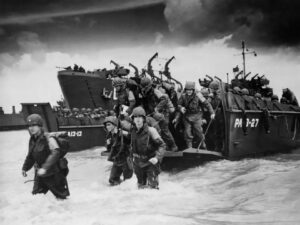
On June 6, 1944, reinforcements disembarked from a landing barge at Normandy. Hulton Archive/Getty Images
The opportunity in 1944 for an American army and navy to unravel from racial, religious, economic and political differences was real: Those soldiers’ and sailors’ ancestors had fought each other in America’s most destructive war, the Civil War, 80 years before Normandy. The racial, political and personal convictions left by that war endured in 1944. But the things that those soldiers and sailors had in common endured as well. They had lived together through the Great Depression, with its joblessness and poverty. They had endured the loss of our heartland in the Dust Bowl, with its migrations and abandonment. And they had seen firsthand how their country emerged from those disasters to create jobs, building dams and skyscrapers; manufacturing cars, boats and airplanes; and building railroads. The soldiers and sailors who landed in Normandy lived in a country that provided real hope for them and for their families, not just the bankers, lawyers and doctors, but also the farmers, welders, riveters, fishermen, dockworkers and nurses.
They were impossibly young. The majority of those who fought and died were in their early twenties. They loved music, dancing, movies and jeeps. They loved baseball. Two semi-pro players who competed against each other in peace are buried within yards of each other in Normandy.
In sum, they came from a land where freedom meant that instead of dreaming, they had hope for their futures. Instead of wishing, they had opportunity. And despite partisan divides, they knew that it was more important for them to band together to fight, not as Texans or New Englanders, or as children of immigrants, or as Democrats or Republicans or baseball players, but as Americans, united in the belief that some things are worth dying for. They went to war against authoritarianism to preserve the American ideals of liberty and opportunity, goals that America itself had not entirely achieved but knew to be worth the fight.
The immensity of their sacrifices is hard to grasp. Perhaps it is more important to grasp why they were willing to make their sacrifices. The ideals worth fighting for in 1944 are the same ideals that were worth fighting for in 1776, in 1861 and today.
Elections are all that prevent the establishment of authoritarian governments like that of World War II Germany. There are no free and fair elections in Russia, Venezuela, Syria or North Korea. Their rulers have taken power and, in the process, systematically excluded from participation in their fig-leaf elections those who oppose them. They have removed checks and balances from their governmental institutions. They have appointed judges who find ways to enforce their political will. Their legislatures enact laws that institutionalize them. Their military institutions take up arms against their own citizens.
We are not immune. All that must happen for an authoritarian to take control of the United States is that voters do nothing. History teaches that when any one man can undermine elections, the judiciary, the free press and institutions of government, democracy dies and autocratic rule fills the void.
Democracy is hard. Our American practice of it often is uneasy and sometimes messy. Even so, our democracy is much better than government by an authoritarian. These ideals mattered in 1944 to the men and women of D-Day and throughout the world at war.
They matter as much today.
And if remembering those who died on the beaches and battlefields of Normandy on D-Day, if visiting their cemeteries to honor and give thanks for their service is painful, we must remember that those men and women are buried there because they fought for democracy and against authoritarianism.
The surest way for something so bad to happen again is for good people to stand on the sidelines and watch. It also is the surest way to build more cemeteries for the heroic men and women who will be called on to defend what America stands for.
That is why, 80 years on, D-Day matters.
Jack Woodville London is a Texas-based veteran, military historian and author of the WWII trilogy French Letters. London is a featured VIP speaker at events for the 80th anniversary of the D-Day landings at Omaha and Utah Beaches in Normandy, France.